
What's new

Fri, Apr 24, 2026

Milestone number 1 of the upcoming 6.0.0 release of RDF4J is now available for download.

RDF4J 6.0.0 is a major release of the RDF4J framework, focusing on dependency upgrades, LMDB improvements, and HTTP client improvements.

Please note that RDF4J 6.0.0-M1 requires Java 25.

Some of the highlights covered in this first milestone:

  • Upgrade to Java 25 as the minimally-required version of Java
  • Introduction of a pluggable HTTP client SPI with Apache HttpComponents 5 and JDK built-in backends
  • Migration from Apache HttpComponents 4 to the new HTTP client facade

This milestone build is not yet feature-complete, but we are putting it out to receive early feedback on all the improvements we have put in.

Upgrade notes

RDF4J 6.0.0 contains several backward incompatible changes.

HTTP client migration

RDF4J previously used Apache HttpComponents 4 as its sole HTTP client, with Apache HttpComponents 4 types directly exposed in the public API. In 6.0.0, this dependency has been replaced by a new HTTP-client-agnostic facade. Apache HttpComponents 4 is no longer exposed through the rdf4j-http-client public API or required as a transitive dependency of rdf4j-http-client for standard use.

For most users, no dependency changes are required. The rdf4j-http-client artifact continues to bundle both built-in backend implementations as runtime dependencies, so upgrading the RDF4J version is sufficient for standard use cases.

Two HTTP client backends are now available:

  • Apache HttpComponents 5 (rdf4j-http-client-apache5) - the default backend when on the classpath.
  • JDK built-in HTTP client (rdf4j-http-client-jdk) - a zero-dependency alternative using the JDK java.net.http.HttpClient API.

To select a specific backend, set the rdf4j.http.client.factory system property to either apache5 or jdk:

-Drdf4j.http.client.factory=jdk

If you previously configured connection pooling or timeouts via system properties on SharedHttpClientSessionManager, those properties are still supported:

  • org.eclipse.rdf4j.client.http.maxConnPerRoute (default: 25)
  • org.eclipse.rdf4j.client.http.maxConnTotal (default: 50)
  • org.eclipse.rdf4j.client.http.connectionTimeout (default: 30 000 ms)
  • org.eclipse.rdf4j.client.http.connectionRequestTimeout

For a minimal-footprint deployment without Apache HttpComponents 5, exclude rdf4j-http-client-apache5 and ensure rdf4j-http-client-jdk is on the classpath.

Developer-facing changes

The following public API methods previously exposed org.apache.http.client.HttpClient from Apache HttpComponents 4 and have been replaced (GH-5723):

Old methodReplacement
HttpClientDependent#getHttpClient() returns org.apache.http.client.HttpClientReturns org.eclipse.rdf4j.http.client.spi.RDF4JHttpClient
HttpClientDependent#setHttpClient(HttpClient)Accepts org.eclipse.rdf4j.http.client.spi.RDF4JHttpClient
HttpClientSessionManager#getHttpClient() returns org.apache.http.client.HttpClientReturns org.eclipse.rdf4j.http.client.spi.RDF4JHttpClient

If your code calls setHttpClient() with a custom Apache HttpComponents 4 client, you must migrate to the new API.

The new rdf4j-http-client-api module defines the HTTP client facade with no third-party HTTP dependencies. The key types are:

  • RDF4JHttpClientFactory - SPI interface discovered via java.util.ServiceLoader; implement this to plug in a custom HTTP backend.
  • RDF4JHttpClient - the HTTP client interface used internally by SPARQLProtocolSession and RDF4JProtocolSession.
  • RDF4JHttpClientConfig - immutable configuration object for timeouts, connection pooling, SSL, and default headers.
  • RDF4JHttpClients - utility class for obtaining the default factory or creating clients.

Use RDF4JHttpClientConfig and RDF4JHttpClients to create a configured client and pass it to a repository or session:

RDF4JHttpClientConfig config = RDF4JHttpClientConfig.newBuilder()
		.connectTimeoutMs(5_000)
		.socketTimeoutMs(30_000)
		.maxConnectionsPerRoute(10)
		.build();

RDF4JHttpClient client = RDF4JHttpClients.newDefaultClient(config);

HTTPRepository repo = new HTTPRepository("http://localhost:8080/rdf4j-server/repositories/myrepo");
repo.setHttpClient(client);

The previous HttpClientBuilders.getSSLTrustAllHttpClientBuilder() helper, which returned an Apache HttpComponents 4 builder, has been replaced by HttpClientBuilders.getSslTrustAllConfig():

RDF4JHttpClientConfig config = HttpClientBuilders.getSslTrustAllConfig();
RDF4JHttpClient client = RDF4JHttpClients.newDefaultClient(config);
repo.setHttpClient(client);

Authentication is now handled via the AuthenticationHandler SPI rather than Apache HttpComponents 4 credential stores. Built-in implementations are provided for basic authentication and bearer tokens:

session.setAuthenticationHandler(new BasicAuthenticationHandler("user", "secret"));
session.setAuthenticationHandler(new BearerTokenAuthenticationHandler("my-token"));
session.setAuthenticationHandler(new BearerTokenAuthenticationHandler(tokenStore::currentToken));

To provide a fully custom HTTP backend, implement RDF4JHttpClientFactory and register it as a java.util.ServiceLoader service in META-INF/services/org.eclipse.rdf4j.http.client.spi.RDF4JHttpClientFactory. To extend the Apache HttpComponents 5 backend with additional configuration, subclass ApacheHC5RDF4JHttpClientFactory and override buildHttpClient(HttpClientBuilder, RDF4JHttpClientConfig).


Thu, Apr 23, 2026

RDF4J 5.3.1 is now available. This is a patch release fixing 2 bugs.

For more details, have a look at the release notes.


Fri, Apr 17, 2026

RDF4J 5.3.0 is now available. This minor release resolves 22 issues between 5.2.2 and 5.3.0 and focuses on better query observability, easier deployment, and targeted performance work across the stack.

Highlights include richer EXPLAIN support with runtime telemetry and Workbench compare mode, a new standalone rdf4j-server-boot distribution for Server and Workbench, faster LMDB/Lucene/DISTINCT-heavy workloads, direct .xlsx and .ods SPARQL result export, and several developer-facing additions such as the experimental query renderer and a fluent ShaclValidator API.

For more details, have a look at the release notes.


About

Eclipse RDF4J™ is a powerful Java framework for processing and handling RDF data. This includes creating, parsing, scalable storage, reasoning and querying with RDF and Linked Data. It offers an easy-to-use API that can be connected to all leading RDF database solutions. It allows you to connect with SPARQL endpoints and create applications that leverage the power of linked data and Semantic Web.
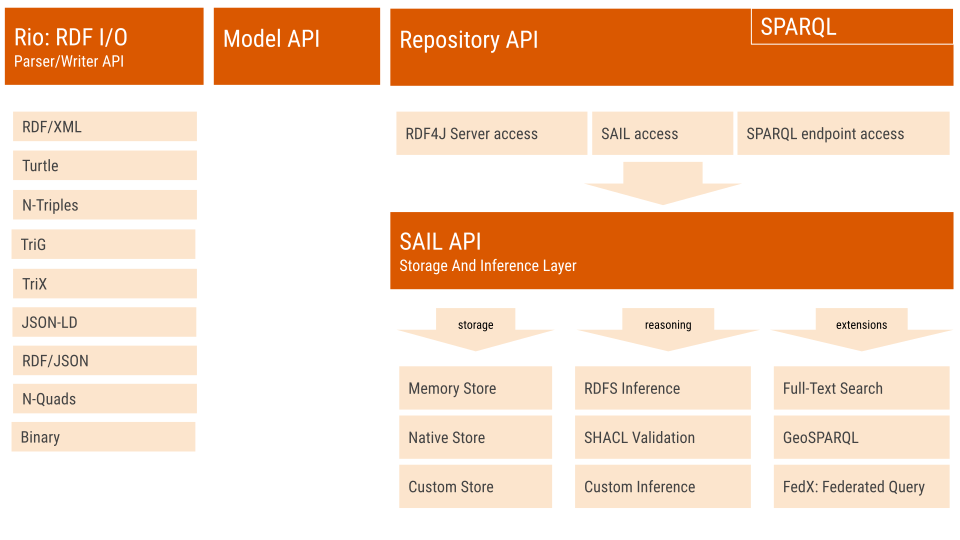

RDF4J Architecture

Back to the top